Conference Interpretation Organization
In a seminar, participants may express themselves in a language referred to as passive, meaning the language undergoing interpretation. In such instances, speakers can follow their active language through various language channels available.
For conferences or meetings that necessitate simultaneous interpretation, the venue is equipped with soundproof booths to facilitate the collaboration of interpreters in teams, with a minimum of two interpreters assigned to each language. At times, interpreters may engage in biactive interpretation, wherein they interpret into their native language and another. This activity requires a team that can alternate every 15 to 30 minutes. During their break, the resting interpreter assists their colleague by providing notes or relevant documents.
The Significance of Interpretation for International Institutions
The ability to communicate without a shared language is indispensable for the operation of all international organizations.
The standard practice is to adopt one or more working languages that all participants must be proficient in. Some conferences or organizations employ multiple listening languages. In such cases, these languages undergo interpretation, making it essential for those who do not speak these languages to express themselves and participate.
For UNESCO:
Two working languages, English and French, are utilized. Additionally, Arabic, Chinese, and Russian are officially employed and, therefore, necessitate interpretation.
For the European Union:
Since 2013, the European Union has employed 24 working languages, posing a considerable challenge and demanding a substantial number of interpreters.
The working languages include German, English, Croatian, Bulgarian, Danish, Spanish, Czech, Estonian, Finnish, Greek, Hungarian, Irish, Italian, Latvian, Lithuanian, Maltese, French, Dutch, Portuguese, Polish, Slovak, Slovenian, Swedish, and Romanian.

 In consecutive interpretation, the interpreter does not speak simultaneously with the speaker but rather during the pauses.
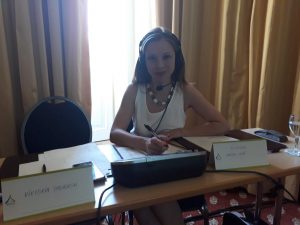 Simultaneous interpretation involves the interpreter speaking concurrently with the speaker, introducing a slight delay. This form of interpretation is widely regarded as one of the most challenging due to the interpreter’s requirement to speak and listen simultaneously, often while utilizing technical equipment. The use of headphones or earphones enables the interpreter to hear the speech, which is then translated and conveyed orally through a microphone. Subsequently, the interpreter transmits the translated speech to individuals equipped with earpieces.